Showing posts with label winter. Show all posts

Friday, February 28, 2014

Birds - to brighten a winter's day

Birds are an indicator of the environment. 
If the birds are in trouble, we know we'll soon be in trouble.
Roger Tory Peterson
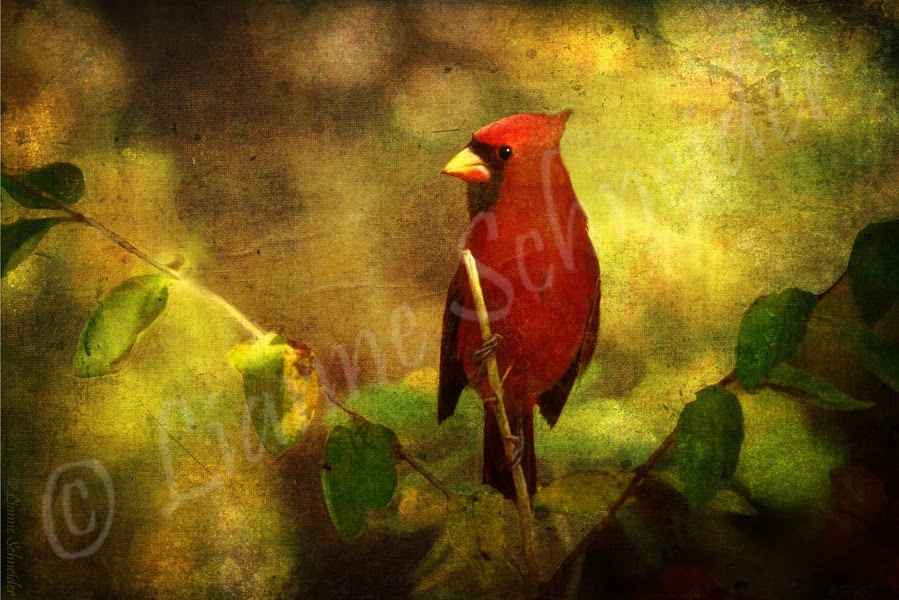
Cheery Red Cardinal
http://lianne-schneider.artistwebsites.com/featured/cheery-red-cardinal-lianne-schneider.html

There aren't many things that can cheer a short, cold, often gray winter day as wonderfully as seeing colorful birds at the feeder outside the window. We're lucky here - we have about 4 pair of cardinals (though one did die the other day I'm sorry to say), blue jays, dozens of goldfinches - which are actually fairly green in winter, ordinary house finches with their red heads, an occasional purple martin, little red wrens, woodpeckers, nuthatches, pretty little titmice, the duller sparrows and chickadees galore. Some of these darling visitors add song to the day as well - cardinals have a particularly sweet and appealing song. 

There are a few myths about birds that winter over - and Birds and Blooms has done a nice job of putting those to rest. The first myth and probably a great concern for many of us this particularly cold winter is that birds will freeze to death if temperatures drop far below zero as they have here many times this year. The fact is, according to the website, birds are very well equipped to "survive the coldest temperatures. They store fat during the short days of winter to keep themselves warm during the long nights. During those freezing nights, they fluff their feathers to trap heat and slow their metabolism to conserve energy. They also look for good places to roost, whether it’s a birdhouse, natural tree cavity, grass thicket, evergreen or shrub."  If you'd be interested in dispelling several other myths about winter birds, you can read the rest here:  http://www.birdsandblooms.com/birding/birding-basics/winter-birds-myths-facts/

Unfortunately, according to the U.S. Fish and Wildlife Service, "birds across the United States are facing more – and more severe – threats to their survival today than ever before." One of the loveliest is a songbird whose habitat is only in northern Michigan - the Kirkland Warbler. There had been hope to take it off the list but it's still on it right now. Fortunately, here in Western New York, none of our winter songbirds are endangered though in really cold winters like this one, they seem to be less numerous. It's important to keep various kinds of bird feeders - nyjer seed, black oil sunflower, mixed seed, cracked corn and even peanuts - filled daily. Winter birds store food internally to create heat. So if you notice a run on your feeders on any given day - except the temperatures to dive!! Let's look out for our feathered friends who bring us so much enjoyment all year round. 


Thursday, February 13, 2014

Trillium Gallery Opening and a St. Jude's Charity Auction

Off to Grandma's - Christmas Morning

I don't know when I've been more excited or felt better about calling myself an artist than I do today.  In spite of the pending storm, tomorrow morning I am driving to Saugerties, NY (in the heart of the Catskills) to attend the grand opening of the new physical Trillium Gallery which is at noon on Saturday, February 15. Why would I drive into a storm for a gallery opening??? Because three of my artworks are hanging for the opening gala!! (I'm praying the worst will be over by morning and cleared up by the time I get there tomorrow afternoon!) I just didn't want to miss the excitement. 

I've been associated with Trillium Gallery since its inception four years ago when the curator, Maureen Maliha opened a small gallery not far from Woodstock. But, unfortunately, its location was pretty much a secret - difficult to find out in the country. The new gallery is right downtown in this absolutely quaint and historic village of Saugerties which hosts nearly a dozen hunter-jumper horse shows (HITS, Inc. which stands for Horse shows in the Sun) from May through September. This brings huge crowds to the village. There are also a number of other huge festivals including a music festival, a garlic festival and an electric dance music festival among other delightful get togethers! Needless to say, it's a fabulous thing to be a part of this new undertaking in such a vibrant cultural center just an hour and a half north of NYC. 

But my good news doesn't end there. While preparing for my trip to the grand opening, I got word from Trillium that the St. Jude Children's Hospital fundraising branch had selected the works of 5 Trillium artists to be auctioned at one of the many fundraising galas they host around the country. I'm so honored to say that the group selected the image posted above as one of the works they would like to have and they intend to auction it at their Atlanta Gala. It's a joy to donate the work for such a worthy cause and one that has always been close to my heart. But it's just such a wonderful affirmation that they selected my work out of the hundreds of incredible artworks showcased at Trillium Gallery Online (www.trilliumgallery.com) I can only hope that it raises a significant amount of money for the children St. Jude Children's Research Hospital helps every year. I congratulate the other artists whose work was also selected for other galas from NYC to Denver.

I have every faith that the snow will be gone, the roads clear, and the weather warmer for Saturday's grand opening. If you are within driving distance, it would be wonderful to have you join us any time after noon for beautiful artwork, good food, and fabulous music. 
 

Thursday, January 30, 2014

Overcoming winter S.A.D.ness

"In the depth of winter, I learned that within me lay an invincible summer."
Albert Camus
Winter Barn
Seasonal Affective Disorder used to be laughed at as the hypochondria of...attention seekers, the lazy, or maybe just the "winter blues" - a harmless enough low feeling that will go away on its own soon enough. Even when I was younger and very active in the winter with snowmobiling, skating, winter parties at the sugar shanty, I still experienced this kind of "dread" as November approached. I'd say over and over, "I hate November." As the years went by, the dread got worse, the low feeling became real depression during the winter months. At first, I chalked it up to personal losses that had occurred in November or early December - my Dad's death, my husband's, my grandfather's. But each year, it got worse and I began to equate winter with the season of my life - that I was entering the "winter" of my life journey and while death didn't exactly terrify me, I wasn't in that big a hurry for it! Moving back up north after years in the south seemed to make things much worse - as my physical mobility became more limited, winters stretched long and drearier. The sudden change to Standard time in October (now November) would hit me like a ton of bricks as the daylight hours were instantly one hour shorter. I'd tell everyone I was going into hibernation and I'd come out again when the time changed in March! And off I'd go into what I called "my cave."
S.A.D. is actually very real for millions of people and for some, downright dangerous. According to the Mayo Clinic, those with severe depression from untreated S.A.D. should not ignore the symptoms. They can get worse and lead to problems if it's not treated. These can include:
  • Suicidal thoughts or behavior
  • Social withdrawal
  • School or work problems
  • Substance abuse
Treatment can help prevent complications, especially if seasonal affective disorder is diagnosed and treated before symptoms get bad.

So...what to do. See a doctor if symptoms persist - you may benefit from antidepressant medications but even if you don't choose this course, a health care professional will be aware of your condition and that's important. But there are lifestyle changes you can try as well - get special real daylight bulbs for your lamps and avoid fluorescent lights if possible. There are also actual light therapy boxes you can use several times a day to increase your exposure to daylight. Go outside - even if you aren't very mobile, bundle up and sit on the porch, the patio, a park bench and soak up the sun for a half hour. Get what exercise you can - you don't have to ski or snowmobile or shovel snow with a bad heart to get a little exercise to raise your serotonin levels. Get CREATIVE - that's finally what saved me. In winter time, I pour myself into my art and writing in between treks up and downstairs for exercise. I think about winter poetically instead of with dread. In fact...I wrote a long poem called, "Even Winter Has Its Joy" and you can hear me read it on this short YouTube video:


I hope you enjoyed that...would love to get your feedback though I apologize for the quality of the artwork - I've worked harder on that in recent years! The poem is from my last book, "Ecclesiastes for Sixty: Seasons in Solitude." 


Monday, January 27, 2014

Midwinter - dreaming of baseball


"There are only two seasons – winter and baseball." 
~ Bill Veeck ~

                                                        former owner of the Cleveland Indians, St. Louis Cardinals and Chicago White Sox

Tinker to Evers to Chance


The poem, "Baseball's Sad Lexicon", also known as "Tinker to Evers to Chance" after its refrain, is a 1910 baseball poem by Franklin Pierce Adams. The poem is presented as a single, rueful stanza from the point of view of a New York Giants fan watching the Chicago Cubs infield complete a double play.

Chicago Cubs infielders Joe Tinker, Johnny Evers, and Frank Chance began playing together with the Cubs in 1902, and formed a double play combination that lasted through April 1912. Their consistently solid fielding and hitting led the Cubs to four National League pennants (1906-8, 1910) and two World Series wins (1907-8). In 1910, New York newspaper columnist Franklin Pierce Adams immortalized the three ballplayers in a short verse. The Cubs won the National League pennant four times between 1906 and 1910, often defeating the Giants en route to the World Series. In fact, the 1907 Chicago Cubs are often referred to as “the best team ever” and there is a book by that name that celebrates this talented team in its entirety.

Adams’ poem was first published in the New York Evening Mail on July 12, 1910. Popular among sportswriters, numerous additional verses were written. The poem gave Tinker, Evers, and Chance increased popularity. It has been credited with their elections to the National Baseball Hall of Fame in 1946.

Off the field, two of the three never spoke to one another – Joe Tinker and John Evers disliked each other immensely and no sign of rapprochement appeared until both were asked to visit Chance as he lay dying. 
  
"Baseball's Sad Lexicon"

These are the saddest of possible words:
"Tinker to Evers to Chance."
Trio of bear cubs, and fleeter than birds,
Tinker and Evers and Chance.
Ruthlessly pricking our gonfalon bubble,*
Making a Giant hit into a double--
Words that are heavy with nothing but trouble:
"Tinker to Evers to Chance."**

* The term "gonfalon" refers to a flag or pennant, and Adams uses the phrase "pricking our gonfalon bubble" to describe the repeated success of the Chicago Cubs and their celebrated infield against their National League rivals, his beloved New York Giants.

** Reprinted in the book In Other Words by Franklin P. Adams (Garden City, N.Y.: Doubleday, Page & Co., 1912)

Credit for the details of the story goes to Wikipedia (entry Tinker to Evers to Chance) and to the Baseball Almanac.

A complete departure for me in terms of subject matter – but the history buff in me couldn’t resist the challenge. The images in this triptych were painted using baseball card pictures taken by photographer Paul Thompson who owned the copyright only for the gold borders that surrounded the original cards. An article in the Smithsonian described the significant departure of Thompson’s portraits from those on other baseball cards – distributed by the American Tobacco Company among other tobacco companies. Thompson’s were chromolithographs which could be printed in color while earlier cards had been black and white.